

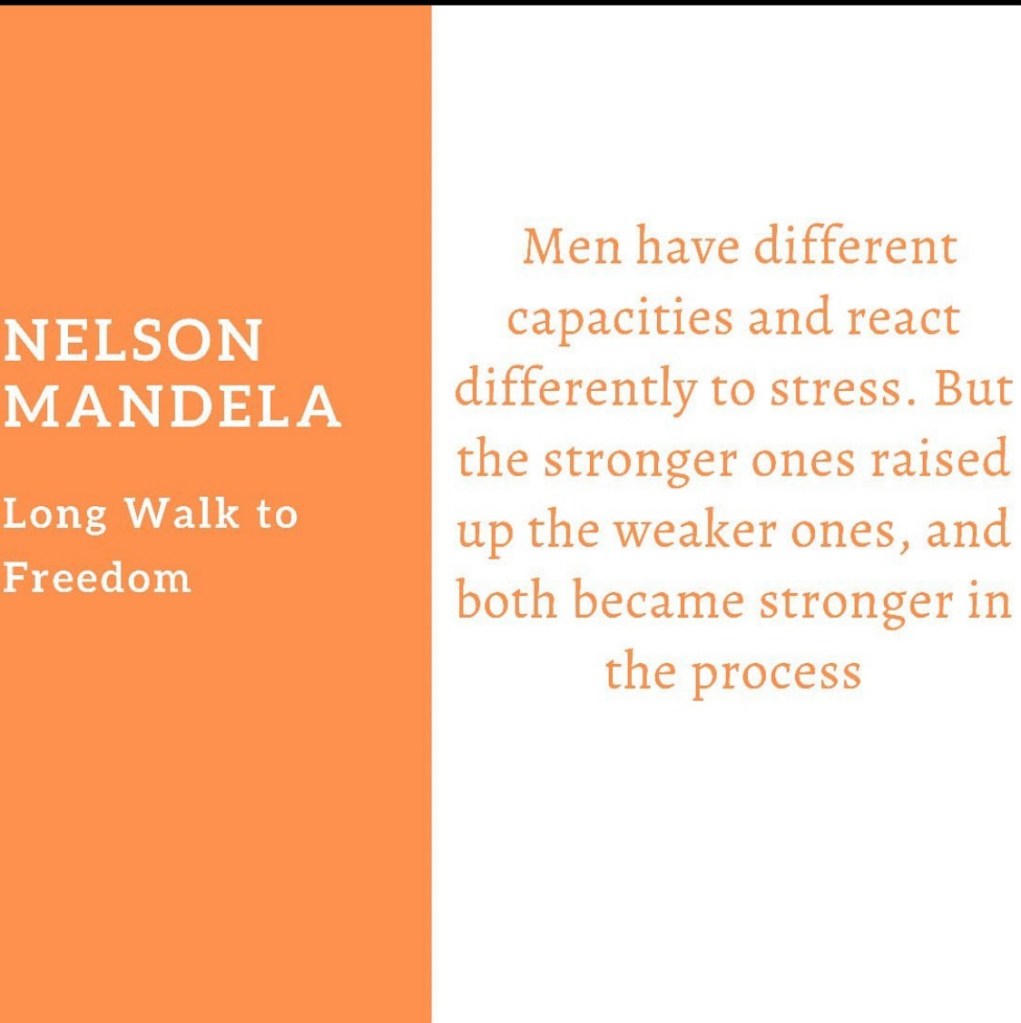
Nelson Mandela’s Long walk to Freedom is one of my favourite autobiographies ever .It is quite a bulky read at 656 pages but was a book that not only humanized a legend but also taught me a lot of life and leadership lessons.
One of the prevailing lessons that run through the book and Madiba’s life was the ethos of community and teamwork.
Mandela was seen as the symbol of the apartheid movement in South Africa but his autobiography details the efforts of other figures like Cyril Ramaphosa, Oliver Tambo,Walter Sisulu etc.
All of these men and Mandela brought their different strengths and weaknesses to what can be described as one of the most pivotal civil rights movements of the 20th century.
As the pictured quote states, we all have different capacities,strengths and weaknesses.Most of us either in school or at work have been assigned to work as part of a group to deliver an outcome (some of us call them projects😉). Working in teams evokes a lot mixed feelings for most of us as it means having to consider or rely on other people and gosh can people be tricky!
Group/team work is great because it often takes collective effort to achieve success in most human endeavor. Different members of the group possess different skills or strengths ,the work gets shared and we can all relieve the pressure on individuals as we pitch in when necessary.
On the flip side,you have members of the group whose weaknesses can feel like a drawback or detract from the end goal.
The natural inclination this instance is to drop the dead weight and look for stronger team mates (cue Anne Robinson’s voice “You are the weakest list, Goodbye! 😀 on the famed BBC Gameshow The Weakest Link
the whole is always greater than the sum of its parts
Aristotle
Mandela’s quote challenged me to think of strengths and weaknesses in a different light.It made me reflect on the following questions in the context of different units of society; families, institutions, organisations, communities etc.
1. What if we looked at individual strengths in a collective fashion?
2. What if the stronger team mates saw their strengths as an advantage that benefit the whole?
3. What if the perceived weakest link was the glue that kept the other strengths working as a unit?
4. Can we ever truly quantify an individual’s contributions in purely numerical terms?
5. How do we objectively define strengths that cater to all abilities?
6. What would society become if we left behind all the percieved weakest links?
I agree that there are no easy answers to the questions above. It also not a concept that comes easily as the world is mostly wired to the survival of the fittest. It’s one that will take a lot intention and seems much more difficult than just shedding the dead weight.
I don’t think there are straight answers but the book made me reflect on how we could view strengths and weaknesses in a different light.

One of the easiest way to start is to begin to question how we see those abilities that don’t fit neatly into broad categories.
Is the weakest link truly weak or do they have a different ability that could utilised differently or in a different context?
Another easy action would be to acknowledge that we all have strengths AND weaknesses which in turn enables us to accommodate/respect other people’s strengths weaknesses. Seems pretty obvious but I never cease to be surprised at how many people can’t seem to hold this nuance particularly in how they relate to others. We see this play out in different elements of society and how much disdain we can hold for people who don’t follow conventional paths and how we narrowly define success.
Mandela’s insights remind me of a truly remarkable individual who realised that no one of us is ever truly self made. Our weakest links could be held up by another’s strongest attribute
Alone, we can do so little; together, we can do so much
Helen Keller
Thank you so much for reading and I am really looking forward to hearing your thoughts and even questions.
 Life thru my lens
Thanks for this enlightening piece.
I love No.3! “What if the perceived weakest link was the glue that kept the other strengths working as a unit?”
Definitely food for thought!
LikeLike
Thank you
LikeLike