Self certified Bibliophile .. I love life, books, learning and people. This blog is a collection of my random musings as I go through this journey towards fulfilling my God given purpose. My mission is to get as many people as i can to enjoy reading and see it as an enjoyable activity. I also believe that we can change and transform our lives and thinking by learning to improve in the little things each day.
It’s been a minute.. But I am back with one of my favourite activities, reading and writing about reading.
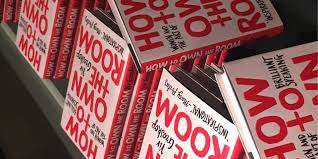
How to Own the room: Women and the art of public speaking by Viv Groskop has been on my bookshelf for a couple of months and decided to add it to November reading list as it’s not too bulky.
It was a book filled with really practical tips on how to be present and carry an audience along when speaking. I really liked the relatability of the scenarios presented.
The author highlights that public speaking is not just about giving once in a lifetime speeches or TED talks and tries to help readers see that public speaking is not something meant for “just a few talented ones”.
She acknowledges that we are not all going to be in front of the biggest stages but shares ideas that anyone can adapt to whatever ‘stage’ they have to speak on. From presenting in a work meeting,facilitating a panel, giving a vote of thanks at a wedding,the book contains really actionable tips to help conquer the irrational fear most people have about speaking in front of other people.
It is a book written for women but the practical tips and exercises at the end of each chapter would really benefit anyone.The book is divided into 11 chapters with 8 of them highlighting the very different public speaking styles of women like Michelle Obama,Chinamanda Ngozi Adichie,Oprah Winfrey Susan Cain, Angela Merkel,Joan Rivers, Christine Lagarde, Emma Watson ,Virginia Woolf etc .
The author gives an analysis of their speaking styles and how we can all adapt or refine our speaking styles based on personality, context or ideas we are presenting. The author illlustrates with her character study that there are powerful speakers out there in every personality type. She successfully shows that introversion is not a good enough reason to avoid public speaking.
I particularly loved the conversational style of writing and reading it felt like listening to a good friend or coach giving you advice and sometimes telling you off for not believing in yourself.
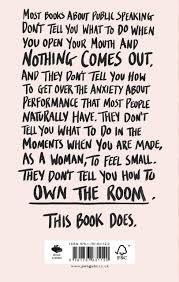
Back page of the book
Some of my favourite quotes and ideas that really resonated were the headers of the sections that the chapters were divided into. These are just a few of them;
Your imperfect presence is enough– To own the room does not mean you need to blow everyone away with your charisma and greatness. It means that, instead of being overwhelmed by the speech and trying to mould yourself into something you are not, you find ways of being yourself and making the speech fit around you even if you are a quiet modest person.
The more complex your ideas,the slower your speech– As a rule, going more slowly than you think you need to is a good idea. Those who pause naturally 3.5 times per minute,are the most successful at influencing their audience.
Take an attitude towards criticism:either embrace it or ignore it
You don’t have to be a great speaker to give an amazing speech
It’s ok to speak from notes
Show us what we have in common with you
Holding back can be just as powerful as holding forth
It is not really a book geared to the content or what makes a great speech but more geared to the how to make a great speech. As the author herself states It is a book about how to be powerful in your speaking
It was a really great read and is one I would recommend to anyone (women especially)who is uncomfortable with the idea of public speaking and is looking for helpful tips on how to become confident in speaking to an audience of any size.
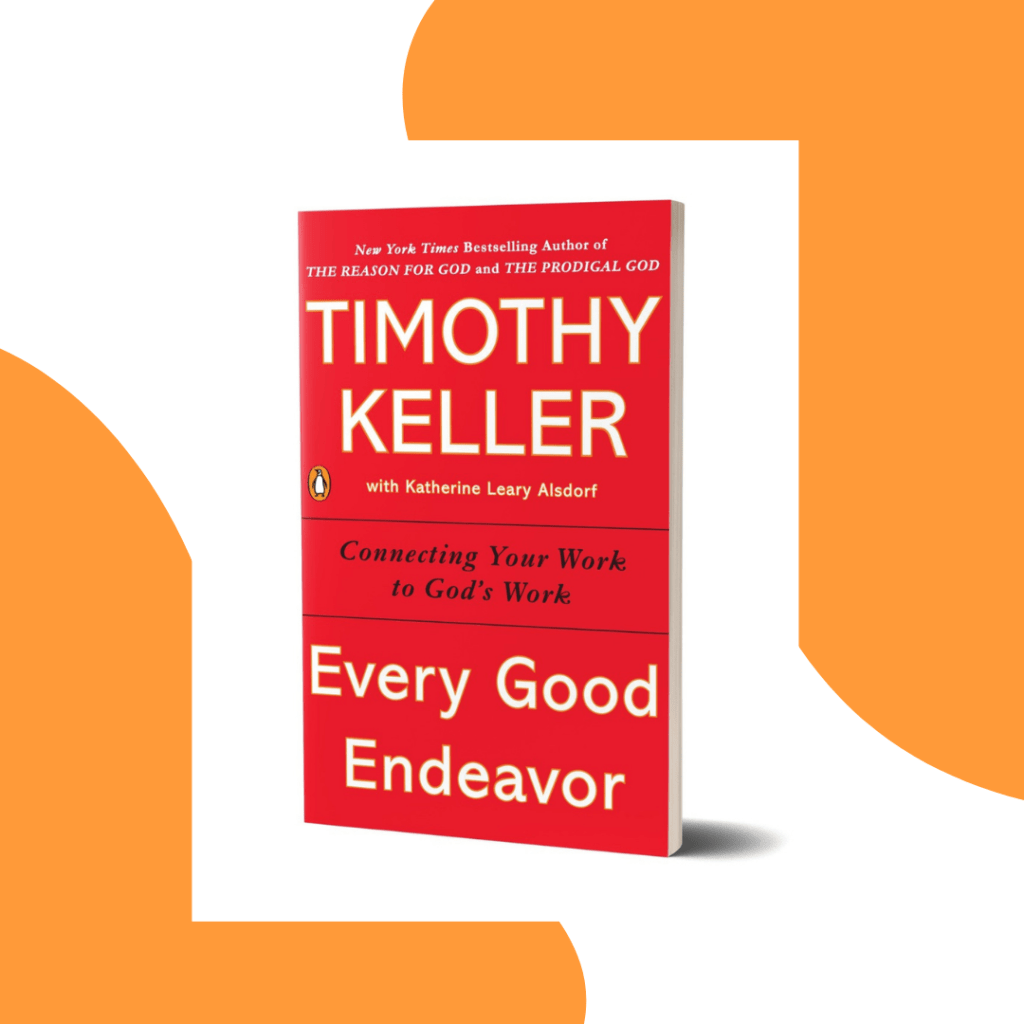
My Christian faith is a vital part of who I am and hope to be. It is the anchor of my convictions and values. Which is why Every Good Endeavour by Timothy Keller was such an amazing read for me.
We are often faced with varying thoughts when it comes to work with one of the biggest questions being How can I find fulfilment in my work?
The author tries to tackle this and a lot of other issues from the perspective of the Christian faith. He explores the contradictions and emotions that work brings up in most christains.The book gives helpful ideas from the Bible on the mindset a christian should have towards their work.The author takes a very balanced approach on how we should approach work and even how we should relate to non-christians in the marketplace.
Please see below some of my favourite quotes from the book;
Work is not all there is to life. You will not have a meaningful life without work, but you cannot say that your work is the meaning of your life.
Work is an important part of life and the author addresses and gives biblical perspective on why we would want to work. He draws on the book of Genesis, where’s Gods creative design of the earth can be seen as a form of work. This is what God set up as an ideal for people to aspire to.
Work was therefore not something done out of necessity, but something to contributing to the world and the good of others.
At the same time, he notes that it is important that work is not seen as the only meaning of life but a means to glorify God and serve others.
There may be no better way to love your neighbor, whether you are writing parking tickets, software, or books, than to simply do your work. But only skillful, competent work will do.
Dorothy Sayers writes, The church’s approach to an intelligent carpenter is usually confined to exhorting him to not be drunk and disorderly in his leisure hours and to come to church on Sundays. What the church should be telling him is this: that the very first demand that his religion makes upon him is that he should make good tables.
The two quotes above highlight a point which author emphasises in the book.
Faith should influence how a Christian works which means the pursuit of excellence is paramount. The author highlights that the original design of God for work was for it to be a calling.He states that the way we approach our work can be a form of worship regardless of the kind of work we do. If we view through this lens it makes it easier to put in our best and serve others to the best of our ability.
It means that all jobs—not merely so-called “helping professions”—are fundamentally ways of loving your neighbor. Christians do not have to do direct ministry or nonprofit charitable work in order to love others through their jobs
Your daily work is ultimately an act of worship to the God who called and equipped you to do it—no matter what kind of work it is. In the liner notes to his masterpiece A Love Supreme, John Coltrane says it beautifully: This album is a humble offering to Him. An attempt to say “THANK YOU GOD” through our work, even as we do in our hearts and with our tongues. May He help and strengthen all men in every good endeavour.
There seems to be an assumption by most Christians that ‘ministry’ or certain types of altruistic work are the only ones that matter to God.He goes into a lot of historical context into why and how this mindset became pervasive in the church. The author gives us a different framework to allowing the Christian worldview shape how and why we do our work regardless of what sort of work we do.
These are just a few of the other 180 highlights and notes I made as I read through. There is so much to unpack in this book as it relates to faith and work that I don’t think this one book review can do justice to.I found another article that summarises the book quite well. The article gives you a bit more detail but I really do think this is a book that should be read to get a full and broader context for the subject matter.
This is the first book Kindle book I have finished in a long while and this is testament to how much I really enjoyed the content as I am very much a hard copy book girl.It was a really great read and is a book that I would highly recommend to any Christian who has ever wondered about the intersection of work and faith.
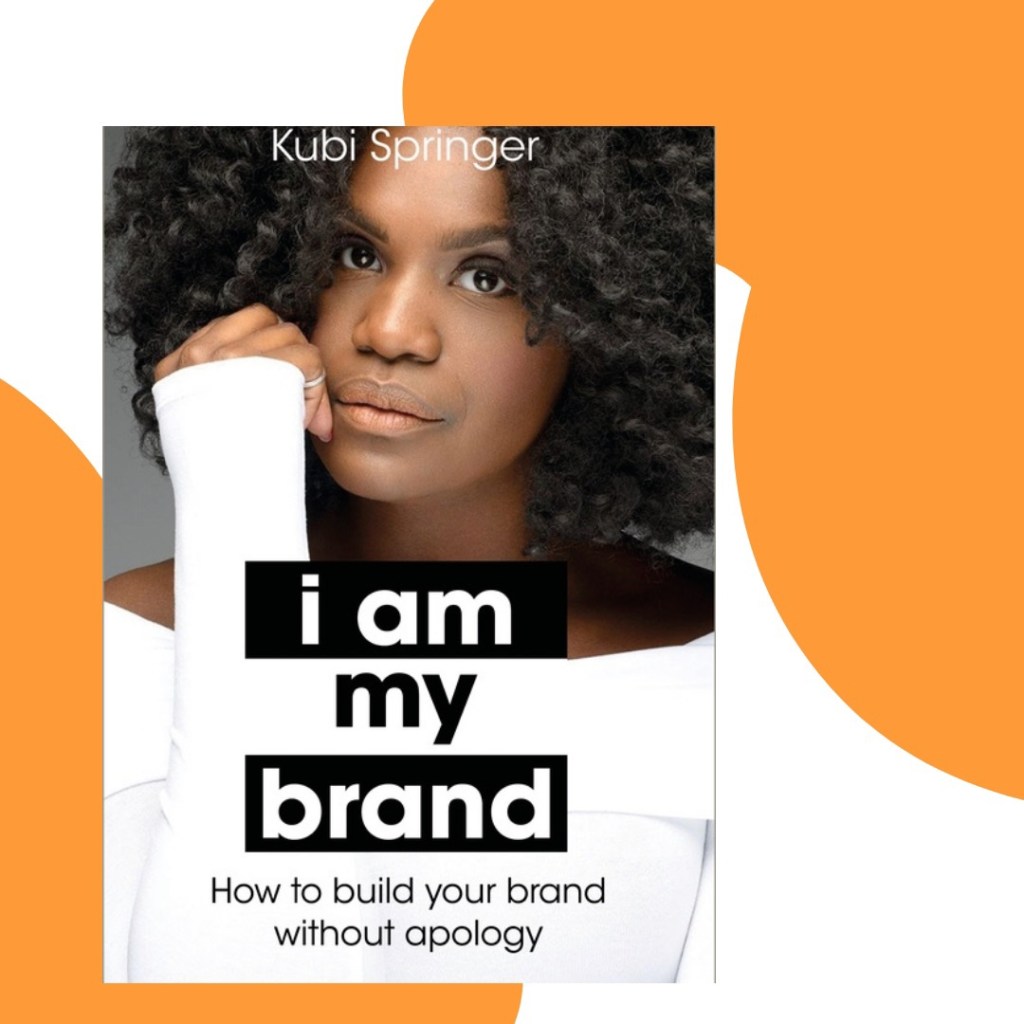
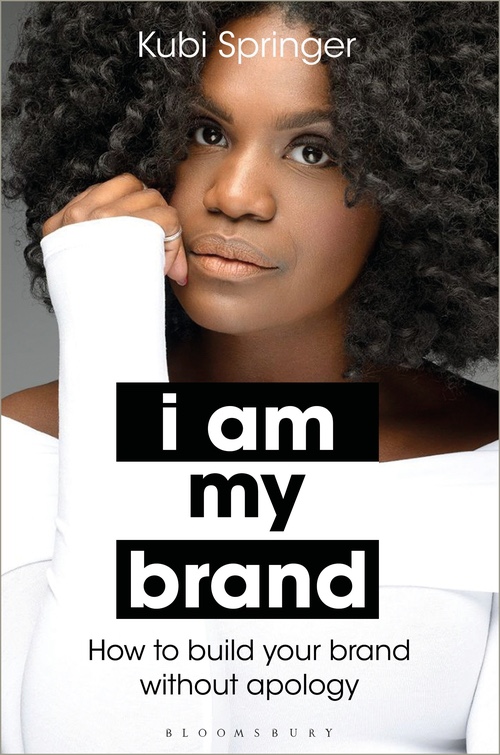
I will start by saying that I really loved this book. It is a really insightful book on what it means to build a personal brand. Practical,no fluff and packed with a lot of tools that anyone can use in building a strong and effective personal brand.
I loved the fact that the author approached branding not just from a business/entrepreneurial perspective. The book outlined ideas anyone can apply to connecting with a diverse audience at work or in life. It was a book that did not just roll out a plethora of cliches but gave really helpful ideas and tools to actually begin the process. There was an activity at the end of every chapter and if you did every activity as you read along, you would have a workable plan by the time you got the end of the book.
I also loved how how the author used her story and those of others in crafting what it entails to be a personal brand that is both loved and reviled. She used examples of brands or people that we all know and those less well known .I have always been wary of the word ‘building a brand’ as it always felt so phoney or disingenuous.
This book helped me see past that reticence as the author explains that a personal brand is less about building a persona but more about an emotional connection with a target audience.
In some ways we all have a target audience.Whether it’s a tribe of people who need your business or service, getting an organisation to see the value you can add to the organisation, or getting funding for your non profit we all have an audience that we need to appeal to and as such a brand that they can relate to.
Books in this genre tend to either over complicate the subject matter by using technical jargon or relying too much on anecdotes with little substance but this book manages to do both without going to the extremes. The author breaks down the process of building a personal brand into eight pillars which were;
Sections 1,2,3,& 8 were mostly aimed at the mindset and reasons why you want to build a personal brand.Sections 4,5,6 go into a lot of branding frameworks and give you the tools required to build a brand both at a personal and organisational level.
There were so many quotes I loved but I particularly resonated with this quote from the section called –Own your truth.
Try to see your personal brand success as a contribution to making others happy.Or try to see how what you do adds value to someone else or something else. We have all been put here for a reason and it’s not just to make money or have a nice house or pay our bills on time or create extreme wealth. Yes those things are lovely and in some cases very necessary but we are here for so much more than that. Your talents,your gifts,character personality are in you for more than just you. Believe it or not you have been uniquely designed to help solve a unique problem in the world.You haven’t been created just for you,you have been created for others to enjoy what you bring. It might sound super corny but the world actually needs what you have. Your world and those in your world really need what you have,to show up without apology.The darkness all around us needs your unique light. When you switch on your torch,your light creates a way for others to see. Yes it might well be scary knowing that there are others dependent on your win but it also very rewarding when it happens.”
Page 21
In the section called –Branding is like dating she states that an effective personal brand is an authentic expression of the individual and a personification of who they really are
Another quote I loved in this section was;
Your why is is therefore the most important part of building an effective personal brand. Without knowing your ‘why’ you are left with nothing more than your capabilities and skills. There are too many people that share the same capabilities and skills as you,so it’s the who you are,not the what you are that matters.
Page 77
I also particularly loved the 12 brand archetypes she described in the section called – Your difference is your strength.The 12 brand archetypes defined in the book are;
1.The Sage 2.The Innocent 3. The Explorer 4. The Ruler 5. The Creator 6. The Caregiver 7.The Magician 8.The Hero 9.The Rebel 10.The Lover 11. The Jester 12. The Regular guy or girl
Based on the definitions and the work at the end of the chapter I ended up defining myself as a cross between 1,3,5 and 12.(a lot I know 😀). If you end up buying or reading the book this is one activity you should definitely not miss out on.
You can probably tell that this a book I really enjoyed and it is one that I will definitely be going back to again and again.
I would highly recommend it to anyone looking for some tips and techniques on building an effective brand. Asides from the branding tips there are also lessons that can be learned from the author’s story and interviews by other business leaders.
One of the things I have really enjoyed in the last few months is catching up with family and friends in person. I know we have had to make do with tech in the last 18 months but the conversations you have with people in the flesh are just richer.
And it’s made me think about deep conversations.
I read an article on cultivating friendships which highlighted that the quality of a conversation is based on the quality of questions posed by those involved.
I think mundane small talk e.g. the weather, cost of children’s school uniforms(don’t get me started on this one ), what is the best air fryer etc are necessary.
My natural inclination though especially when I am with people I care about is to want to go deeper BUT within the boundaries of what they WANT to share.
There is a real delicate balance between wanting to go deep and being nosy. It’s a balance that I really struggle with and one of the reasons why some of my conversations stay superficial as I am a bit cautious about not overstepping other people’s boundaries.
Picture credit – Michael bliss on Pinterest
See below a few pointers from the article on asking good questions when you meet up with family and friends;
A good question shows people you care about them and value what they think. It moves conversation deeper in a natural way. Consider what questions you want to ask someone when you’re on your way to meet them.
Here are several examples:
🔸What are a few themes in your life right now? 🔸What are a few things on your mind these days? 🔸What are you encouraged about recently? 🔸What has been discouraging to you? 🔸How are things going at home (or at work, or at school)? 🔸What are you reading recently, and what has stood out to you from it?
These are just examples and you might need to find a few go-to questions that work for you and then stay curious and keep asking more. Relationships are beautiful when we can share each other’s joys and burdens.
Anything is possible when you have the right people there to support you.
Misty Copeland
Weekends tend to be a time we meet up with people we care about so I hope this helps you in some way to frame or at least engage in deeper conversations. Please also share in the comments any other questions that you think will encourage deeper conversations.
I am back and hopefully for another good stretch of writing consistently.Life really does throw curve balls and I am learning to roll with them and not beat myself up about things. I thought a book review would be a great way to ease myself back in to writing in long form.
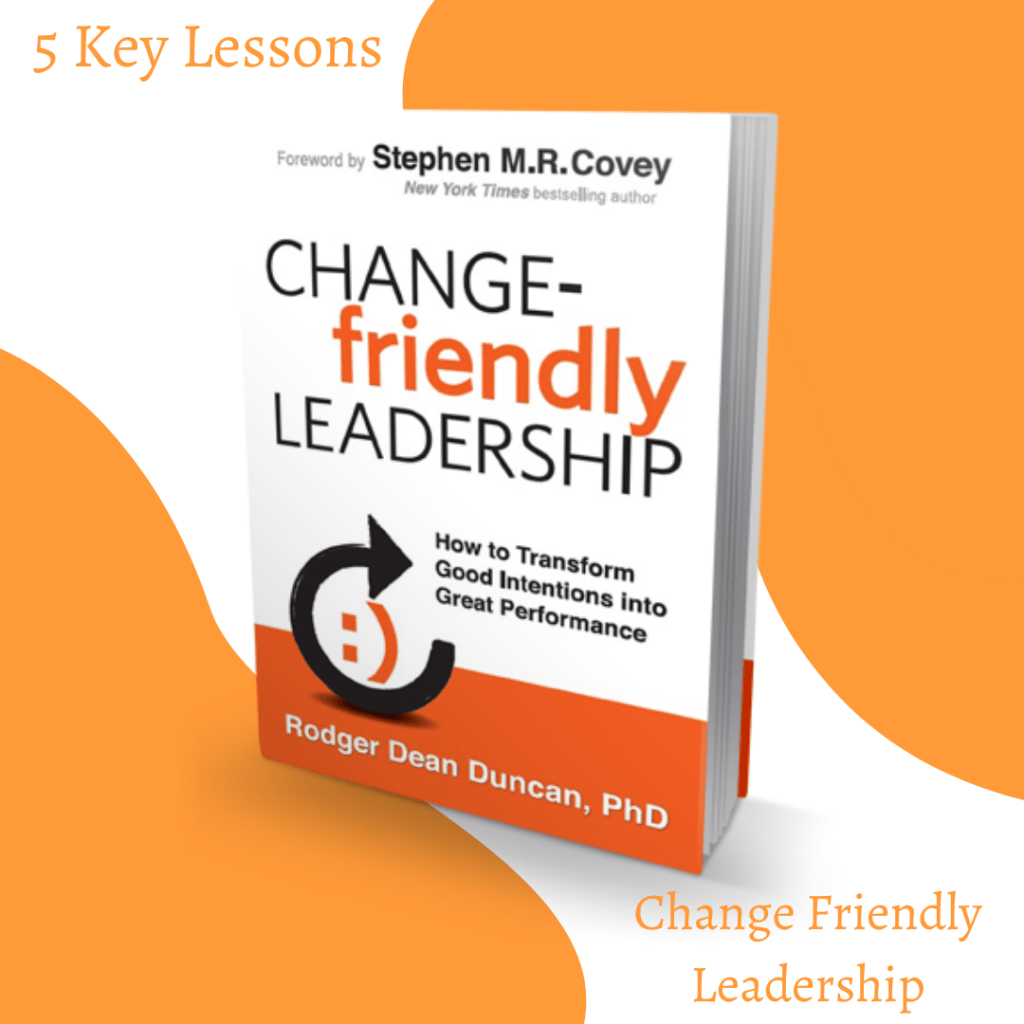
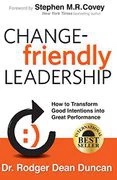
Change Friendly Leadership by Dr Rodger Dean Duncan was a team secret santa gift last Christmas. I remember noticing that everyone else got really funny and cute gifts and I got a book.Not just a book but a book on change and leadership!
People who know me would probably think it was the perfect gift. But I felt both flattered and bemused. I really appreciated the gift as I love books but I also pondered on being the only person with a serious gift. Did I give out vibes of someone who took herself too seriously? I certainly didn’t want to come off as THAT person!
It was a thought that was forever banished when I eventually got round to reading the book in July this year. Now I can only say thank you to my now ex-colleague (but still friend). It was such a fantastic read and a book that I am so glad to have on my bookshelf. Even though I work in the change,transformation and improvement space, I believe everyone manages change in some form or the other.
As with most books I read,I try to distill key lessons or ideas and thought to share my five key ones from this book.I have adapted these lessons and they can be applied in any change context i.e. personal and organisational.
The book was written by seasoned change consultant, Dr Rodger Dean Duncan who owns a consulting practice that focuses on leadership and performance improvement.
In the book he explores why despite the good intentions of leaders,most change efforts have a high failure ratio. In the book he gives frameworks to tackle the often overlooked softer elements of successful change; the humans impacted.
The frameworks provided look at ways to involve and motivate the individuals who will be most affected by the changes being proposed. Whether it’s trying to convince your family to move cities or convincing your friends to run a 10k for charity, these are lessons that we can all apply to carry people along on any change effort.
Change can be stressful
Think about it! Most of the change that we go through in life is accompanied by some sort of stress. Moving house, having a baby, getting a qualification,building an exercise habit etc. There is some sort of stress involved in changing as it requires people leaving comfort zones.
Comfort zones are called that because they are comfortable. The stress results from a challenge to that feeling of comfort.The author explains that the job of a change friendly leader is not look for ways to handle the resistance but look for ways to address the concerns around the stress that accompanies change.
Acknowledging that change causes stress also makes you more empathetic to the sometimes negative feelings it induces in people.
You can rent a man’s back and hands but you must earn his head and heart. Change really is a big deal. Work hard to accommodate people’s feelings – their heads,hearts and hopes and your change effort can be one of the success stories.
Page 2
Tend the garden
The author illustrates that one of the biggest challenges we have with navigating change is viewing it as a linear sequence rather than an organic process. Change almost never occurs the way it was planned.
The journey is never linear.Most people fail at changing not because of a lack of resources, discipline, time etc but due to unrealistic expectations.
Anyone who gardens knows that a lot of energy must be expended in creating a nurturing environment.They also know that gardens do not bloom overnight, it takes time.They also acknowledge that there are other factors that can affect the growth of their garden and take steps to plan and mitigate against these factors. The author illustrates that this is the mindset that must be employed when approaching any change effort;tending and nurturing.
Change-friendly practitioners know that their most important legacy to an organisation is not just in orchestrating a single transformation. Their most important legacy is teaching the organisation how to change and perpetually adapt and in helping its people muster the will to do so.
Page 29
Build Trust
The author goes into a lot of detail about what great leadership is (and isn’t). Building trust was the central theme of this part of the book.You certainly cannot build trust without being honest.
And honesty has to be demonstrated in a number of ways; honesty in putting the needs of others ahead of yours, honesty in communicating information clearly, honesty in welcoming differing viewpoints and most especially honesty in integrating the values you profess with the behaviours you exhibit. In my experience, nothing scuppers a change effort faster than distrust. And distrust occurs when people can clearly see that you are not ready to role model the change you seek. For example,it’s harder to convince people that exercise is great for them if they have never seen you exercising.
A person is trust-friendly when his behaviours consistently enable him to earn trust,extend trust and be trust. Effective change leaders know how to make trust first in order to make it last.
Page 55
You need to listen
The author states that we are most effective when we talk so other people will listenand when we listen so other people will talk. It seems like such a simple concept but listening can be such a hard skill to master.
I don’t mean hearing what was said but actually engaging with what the other person is saying.The author shares a piece of advice for effective interviewing that I have actually implemented. Ask a good question,listen attentively to the answer and then count silently to five before asking another question. You might think “how does this relate to me I don’t interview for a living?”
Believe me,we are all interviewers in one way or the other. If you are a parent, asking your child how their day at school went is a sort of interview.I must confess that this is something I need to get better at and it is one of the parts of the book that I am actively implementing.
If you resist the temptation to respond too quickly to the answer, you will discover something almost magical. The other person will either expand on what he’s already said or he will go in a different direction.Either way, he is expanding his response and you get a clearer view into his head and heart.
Page 104
There is no ‘I’ in team.
The author states that the most effective teams are those where teammates can compliment each other without embarrassment and disagree without fear. It is often implied that being a good team player means always agreeing with each other about everything but I find that the best teams are those who have established ways to handle civil disagreements.I also really liked the author’s take on the five conditions to create an enabling team environment .They are;
1.A real team not just in name only
2. A compelling purpose that kindles the enthusiasm of the team
3. A reinforcing framework that promotes and enables rather than inhibits team achievement
4. A nurturing context and not just lip service support
5. Access individually and collectively to skillful coaching on teamwork issues
Even though the above was specifically crafted for organisational teams, I believe it can adapted in various forms to work in any team context. I use the word team here to define any group of people working together to achieve a common goal.A sports team,church volunteers,members of a family,etc. All of these examples are working together to achieve something and can adapt at least one of the above either to implement a change or achieve collective goals.
Interdependent people combine their own efforts with the efforts of others to achieve their greatest success- Stephen R. Covey
Page 148
Change friendly leadership was a really great,simple read. It contained a lot of really practical tips and frameworks that can be adapted and personalised to your specific change context. I would highly recommend it to anyone who is interested in becoming more effective in leading change both for themselves and others.
*please note that the link above is an affiliate link that earns me a small commission at no extra cost to you*
Thank you so much for reading and I hope you found these lessons helpful and hope you can apply them in some form in the coming weeks and months.Have a lovely new month and quarter ahead.




 Life thru my lens